
Multimodal Computational Methods
We develop methods to locate relevant intervals in physiological recordings and relate them to symptoms, activity, and care events without reducing a long history to a single average.
Models and benchmarksWe develop computational methods for multimodal AI agents that retrieve and interpret evidence from wearable signals, electronic health records, and patient-reported experiences. We study how these agents can help patients and care teams understand changes in health between visits, and how AI co-scientists can help researchers test hypotheses across large biomedical datasets.

We develop methods to locate relevant intervals in physiological recordings and relate them to symptoms, activity, and care events without reducing a long history to a single average.
Models and benchmarksWe use portal messages, interviews, and behavioral studies to identify what patients need between visits and to evaluate whether an agent’s explanations address those needs.
Studies and evaluationWe study how agents can support patients over time, when a clinician should review a proposed action, and how researchers can verify an agent’s analysis against its data and code.
Agent supervisionComputational medicine
Our methods research focuses on representations that let AI reason across physiological time series, clinical records, and patient-generated data. We investigate how to preserve temporal structure, learn from incomplete observations, and use long health histories efficiently.
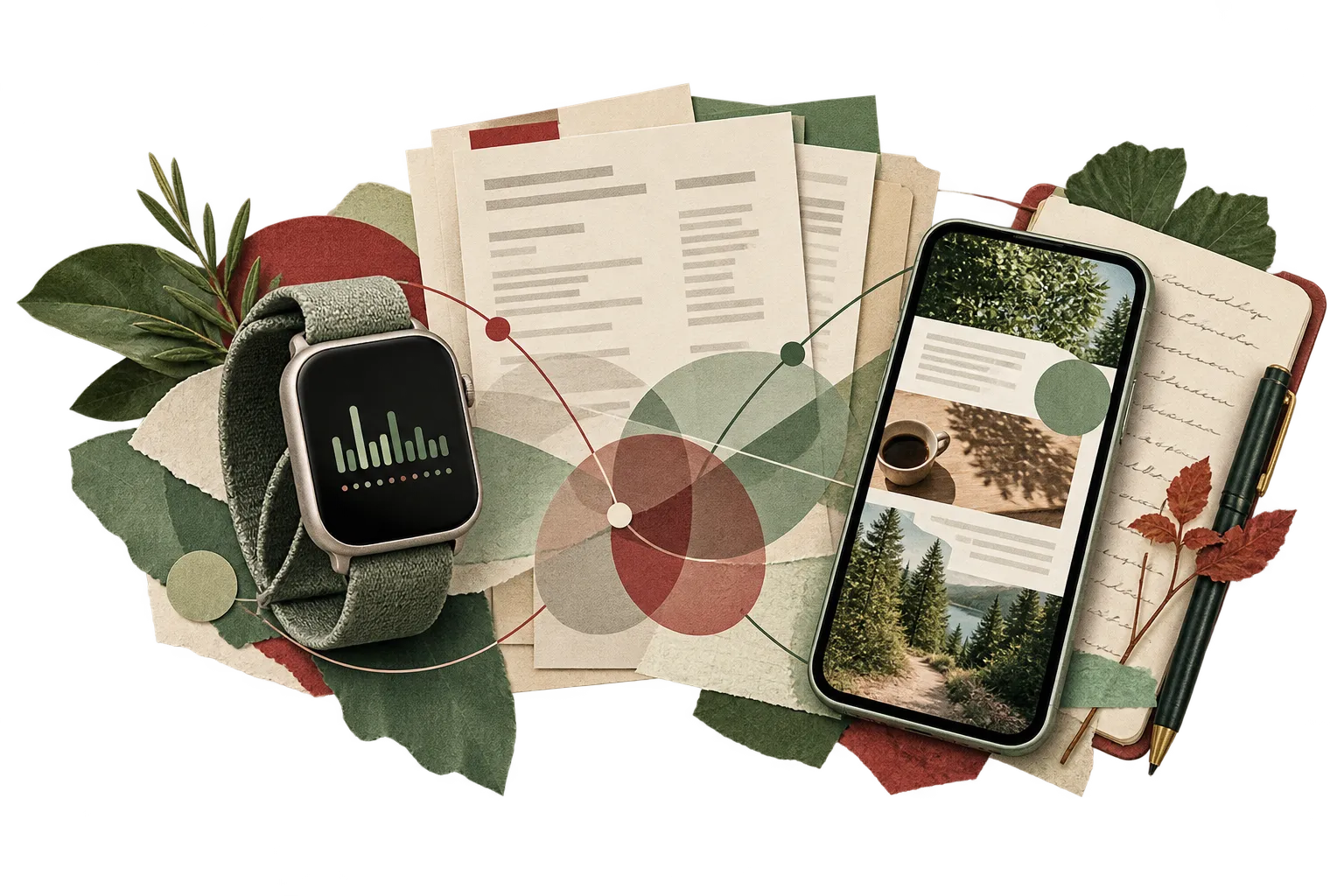
OpenTSLM takes time-series signals as input alongside text. To teach models about patterns that clinical notes rarely describe, TimeCap generates captions directly from wearable recordings. With PocketTSLM, we study how much of that reasoning can happen on a patient’s phone.
Patient-facing AI in practice
Our work on cardiometabolic prevention starts with the questions patients send their care teams about symptoms, test results, and medications. In spine surgery and reproductive endocrinology and infertility (REI), interviews with patients and clinicians guide what an agent should explain before a visit.
In consented studies, patients can explore their health records through chat or voice. We evaluate how well an explanation reflects the record and whether it helps patients prepare for a conversation with their care team.


Phones and wearables can help us study health outside the clinic. They also shape how we spend our time. We investigate both their role in prevention and the challenges of social-media and smartphone use.
In our My Heart Counts collaboration, wearable measurements and participants' experiences help us study cardiovascular health and physical-activity coaching. These studies also inform how we develop and evaluate multimodal models.
We study patterns of smartphone use, problematic social-media use, and interventions that help people make their own choices. Our work examines what app activity reveals beyond screen time and how to evaluate changes in behavior and wellbeing.
We study how agents can help investigators test whether findings hold across cohorts, devices, and clinical settings. In Heartwood, the investigator can review the proposed analysis before it runs and trace each result back to the data and code.
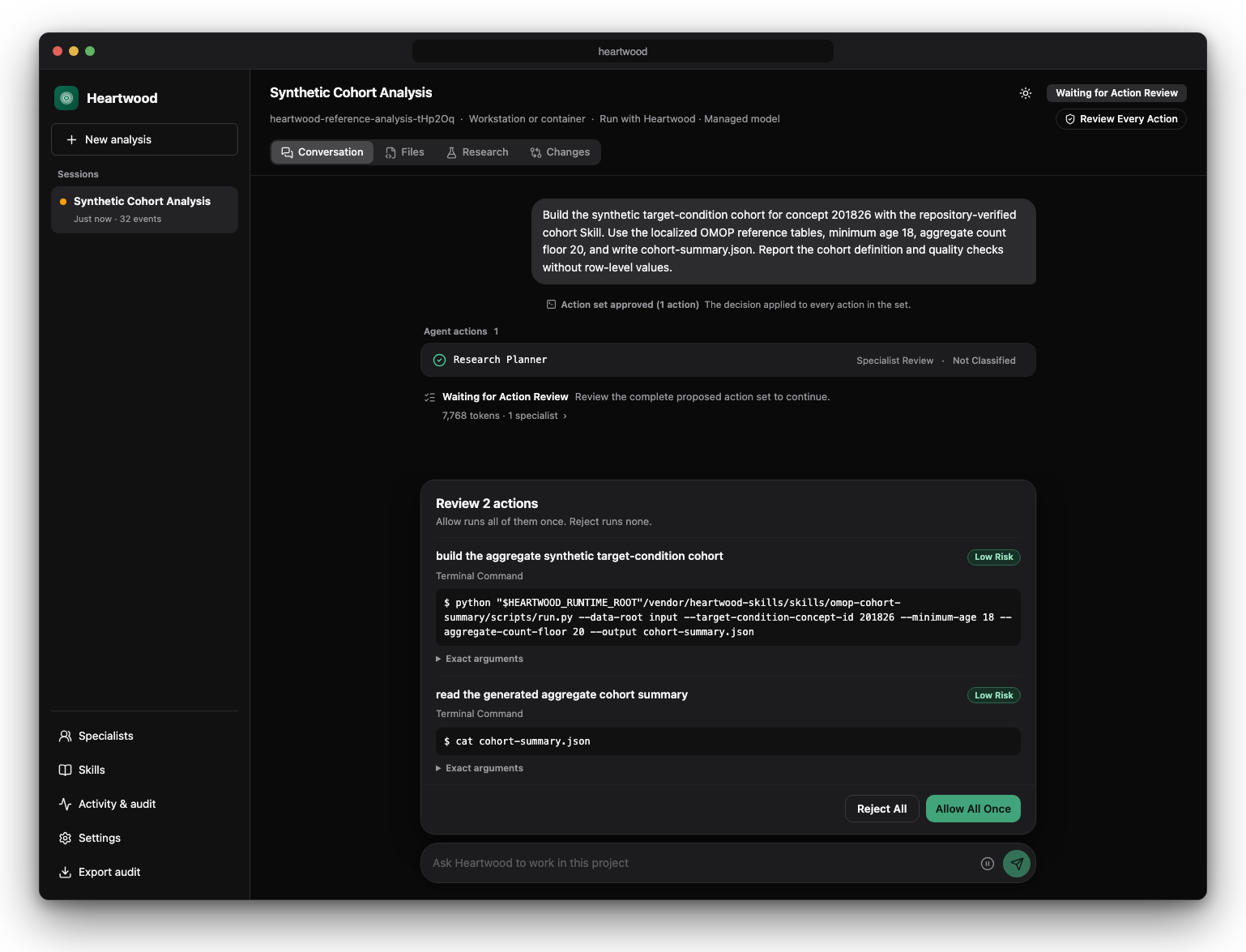
Turn a scientific question into a plan a researcher can review.
Use tools to inspect data, run analyses, and investigate errors.
Keep methods, outputs, and decisions available for others to check.

We share models, code, and research tools so other teams can inspect, adapt, and extend our work. We are developing Grove and Trove to make building applications and running studies easier.
We welcome code contributions, documentation, reproducible examples, and feedback from patients, clinicians, and researchers.
Find a way to contributeWe welcome students, researchers, engineers, and collaborators interested in multimodal models, patient-facing AI, digital wellbeing, and biomedical research agents.
Journal article · 2023
Vancouver-style reference
Aalami O, Hittle M, Ravi V, Griffin A, Schmiedmayer P, Shenoy V, et al. CardinalKit: open-source standards-based, interoperable mobile development platform to help translate the promise of digital health. JAMIA Open. 2023;6(3):ooad044. https://doi.org/10.1093/jamiaopen/ooad044
@article{aalami2023cardinalkit,
  author = {Aalami, Oliver and Hittle, Mike and Ravi, Vishnu and Griffin, Ashley and Schmiedmayer, Paul and Shenoy, Varun and Gutierrez, Santiago and Venook, Ross},
  title = {{CardinalKit}: open-source standards-based, interoperable mobile development platform to help translate the promise of digital health},
  journal = {JAMIA Open},
  volume = {6},
  number = {3},
  pages = {ooad044},
  year = {2023},
  month = {7},
  date = {2023-07-19},
  doi = {10.1093/jamiaopen/ooad044},
  url = {https://doi.org/10.1093/jamiaopen/ooad044}
}Preprint · 2025
Vancouver-style reference
Bauer A, Bosl W, Aalami O, Schmiedmayer P. Toward Scalable Access to Neurodevelopmental Screening: Insights, Implementation, and Challenges [Preprint]. arXiv. 2025. https://doi.org/10.48550/arXiv.2503.13472
@unpublished{bauer2025neurodevelopmental,
  author    = {Bauer, Andreas and Bosl, William and Aalami, Oliver and Schmiedmayer, Paul},
  title     = {Toward Scalable Access to Neurodevelopmental Screening: Insights, Implementation, and Challenges},
  journal   = {arXiv},
  publisher = {arXiv},
  year      = {2025},
  doi       = {10.48550/arXiv.2503.13472},
  url       = {https://arxiv.org/abs/2503.13472},
  note      = {arXiv:2503.13472}
}Journal article · 2026
Vancouver-style reference
Bikia V, Schmiedmayer P, Zahedivash A, Aalami L, Rao A, Ravi V, et al. Spezi Data Pipeline: Streamlining FHIR-based interoperable digital health data workflows. npj Digital Medicine. 2026;9(1):737. https://doi.org/10.1038/s41746-026-02666-7
@article{bikia2026pipeline,
  author = {Bikia, Vasiliki and Schmiedmayer, Paul and Zahedivash, Aydin and Aalami, Lauren and Rao, Adrit and Ravi, Vishnu and Turk, Matthew and Ceresnak, Scott R. and Aalami, Oliver},
  title = {{Spezi Data Pipeline}: Streamlining {FHIR}-based interoperable digital health data workflows},
  journal = {npj Digital Medicine},
  volume = {9},
  pages = {737},
  year = {2026},
  month = {5},
  date = {2026-05-12},
  doi = {10.1038/s41746-026-02666-7},
  url = {https://www.nature.com/articles/s41746-026-02666-7},
  number = {1}
}Preprint · 2026
Vancouver-style reference
Chen T, Stoffregen T, Xu M, Kaar T, Maritsch M, Pompei G, et al. OpenTSLM TeeMoE: A Unified Time-Series Language Model for Forecasting, Contextual Prediction, and Reasoning [Preprint]. arXiv. 2026. https://doi.org/10.48550/arXiv.2609.40265
@unpublished{chen2026teemoe,
  author = {Chen, Tony and Stoffregen, Timo and Xu, Maxwell and Kaar, Thomas and Maritsch, Martin and Pompei, Geremia and Zumarraga, Nicolas and Jakob, Robert and Schmiedmayer, Paul and Langer, Patrick and Liu, Juncheng},
  title = {{OpenTSLM TeeMoE}: A Unified Time-Series Language Model for Forecasting, Contextual Prediction, and Reasoning},
  journal = {arXiv},
  publisher = {arXiv},
  year = {2026},
  month = {9},
  date = {2026-09-30},
  doi = {10.48550/arXiv.2609.40265},
  url = {https://arxiv.org/abs/2609.40265},
  note = {Preprint; arXiv:2609.40265}
}Preprint · 2026
Vancouver-style reference
Grüning D, Beermann V, Enkmann J, Hoch R, Hertwig R, Schmiedmayer P. The ABC of Digital Health: A Framework for Translating Digital Health Interventions into Real-World Applications [Preprint]. arXiv. 2026. https://doi.org/10.48550/arXiv.2607.04381
@unpublished{gruening2026abc,
  author    = {Grüning, David and Beermann, Vincent and Enkmann, Jan and Hoch, Rose and Hertwig, Ralph and Schmiedmayer, Paul},
  title     = {The {ABC} of Digital Health: A Framework for Translating Digital Health Interventions into Real-World Applications},
  journal   = {arXiv},
  publisher = {arXiv},
  year      = {2026},
  doi       = {10.48550/arXiv.2607.04381},
  url       = {https://arxiv.org/abs/2607.04381},
  note      = {arXiv:2607.04381}
}Preprint · 2026
Vancouver-style reference
Grüning DJ, Doeninghaus J, Efchary Z, Kondo Y, Dunnell KF, Fischer LF, et al. The CAST-framework: Measure and model social media use as a multi-level phenomenon through real-world applications [Preprint]. arXiv. 2026. https://doi.org/10.48550/arXiv.2609.15978
@unpublished{gruening2026cast,
  author = {Grüning, David Joachim and Doeninghaus, Jasper and Efchary, Zina and Kondo, Yui and Dunnell, Kevin F. and Fischer, Lennart Felix and Zimmermann, Isabella and Körte, Linnea and Mehlig, Leonard and Riedel, Frederik and Schmiedmayer, Paul},
  title = {The {CAST}-framework: Measure and model social media use as a multi-level phenomenon through real-world applications},
  journal = {arXiv},
  publisher = {arXiv},
  year = {2026},
  month = {9},
  date = {2026-09-14},
  url = {https://arxiv.org/abs/2609.15978},
  doi = {10.48550/arXiv.2609.15978}
}Preprint · 2026
Vancouver-style reference
Grüning DJ, Stock F, Beermann V, Enkmann J, Lorenz-Spreen P, Herzog SM, et al. Digital (self-)nudging: A framework for a continuum of user agency [Preprint]. PsyArXiv. 2026. https://doi.org/10.31234/osf.io/96q45_v1
@unpublished{gruening2026selfnudging,
  author = {Grüning, David Joachim and Stock, Friederike and Beermann, Vincent and Enkmann, Jan and Lorenz-Spreen, Philipp and Herzog, Stefan Michael and Schmiedmayer, Paul and Orben, Amy and Hertwig, Ralph},
  title = {Digital (self-)nudging: A framework for a continuum of user agency},
  journal = {PsyArXiv},
  publisher = {Center for Open Science},
  year = {2026},
  doi = {10.31234/osf.io/96q45_v1},
  url = {https://doi.org/10.31234/osf.io/96q45_v1},
  note = {Preprint}
}Preprint · 2026
Vancouver-style reference
Halder S, Zimmermann I, Körte L, Mehlig L, Schmiedmayer P, Grüning DJ. How do people plan digitally: An in-the-wild investigation of task planning through a smartphone app [Preprint]. arXiv. 2026. https://doi.org/10.48550/arXiv.2609.15904
@unpublished{halder2026planning,
  author = {Halder, Srija and Zimmermann, Isabella and Körte, Linnea and Mehlig, Leonard and Schmiedmayer, Paul and Grüning, David Joachim},
  title = {How do people plan digitally: An in-the-wild investigation of task planning through a smartphone app},
  journal = {arXiv},
  publisher = {arXiv},
  year = {2026},
  month = {9},
  date = {2026-09-14},
  doi = {10.48550/arXiv.2609.15904},
  url = {https://arxiv.org/abs/2609.15904},
  note = {Preprint; arXiv:2609.15904}
}Conference paper · 2025
Vancouver-style reference
Heidekrüger P, Brügge B, Aalami O, Schmiedmayer P. Spatial Continuity: Investigating Use Cases of Spatial Computing for Users with Low Vision. Proceedings of the 27th International ACM SIGACCESS Conference on Computers and Accessibility (ASSETS). 2025:1-4. https://doi.org/10.1145/3663547.3759711
@inproceedings{heidekrueger2025spatial,
  author    = {Heidekrüger, Paul and Brügge, Bernd and Aalami, Oliver and Schmiedmayer, Paul},
  title     = {Spatial Continuity: Investigating Use Cases of Spatial Computing for Users with Low Vision},
  booktitle = {Proceedings of the 27th International ACM SIGACCESS Conference on Computers and Accessibility (ASSETS)},
  publisher = {Association for Computing Machinery},
  pages     = {1--4},
  year      = {2025},
  doi       = {10.1145/3663547.3759711},
  url       = {https://doi.org/10.1145/3663547.3759711}
}Conference paper · 2019
Vancouver-style reference
Henze D, Schmiedmayer P, Brügge B. Fog Horizons – A Theoretical Concept to Enable Dynamic Fog Architectures. Proceedings of the 12th IEEE/ACM International Conference on Utility and Cloud Computing (UCC). 2019:41-50. https://doi.org/10.1145/3344341.3368809
@inproceedings{henze2019foghorizons,
  author = {Henze, Dominic and Schmiedmayer, Paul and Brügge, Bernd},
  title = {Fog Horizons -- A Theoretical Concept to Enable Dynamic Fog Architectures},
  booktitle = {Proceedings of the 12th IEEE/ACM International Conference on Utility and Cloud Computing (UCC)},
  publisher = {Association for Computing Machinery},
  pages = {41--50},
  year = {2019},
  doi = {10.1145/3344341.3368809},
  url = {https://doi.org/10.1145/3344341.3368809}
}Journal article · 2024
Vancouver-style reference
Hoffman SL, Schmiedmayer P, Gala AS, Wilkins KB, Parisi L, Karjagi S, et al. Comprehensive Real Time Remote Monitoring for Parkinson's Disease Using Quantitative DigitoGraphy. npj Parkinson's Disease. 2024;10(1):137. https://doi.org/10.1038/s41531-024-00751-w
@article{hoffman2024parkinson,
  author  = {Hoffman, Shannon L. and Schmiedmayer, Paul and Gala, Aryaman S. and Wilkins, Kevin B. and Parisi, Laura and Karjagi, Shreesh and Negi, Aarushi S. and Revlock, Simon and Coriz, Christopher and Revlock, Jeremy and Ravi, Vishnu and Bronte-Stewart, Helen},
  title   = {Comprehensive Real Time Remote Monitoring for {Parkinson's} Disease Using Quantitative {DigitoGraphy}},
  journal = {npj Parkinson's Disease},
  volume  = {10},
  number  = {1},
  pages   = {137},
  year    = {2024},
  doi     = {10.1038/s41531-024-00751-w},
  url     = {https://doi.org/10.1038/s41531-024-00751-w},
  date = {2024-07-27}
}Conference paper · 2025
Vancouver-style reference
Jörke M, Sapkota S, Warkenthien L, Vainio N, Schmiedmayer P, Brunskill E, et al. GPTCoach: Towards LLM-Based Physical Activity Coaching. Proceedings of the 2025 CHI Conference on Human Factors in Computing Systems. 2025. https://doi.org/10.1145/3706598.3713819
@inproceedings{joerke2025gptcoach,
  author    = {Jörke, Matthew and Sapkota, Shardul and Warkenthien, Lyndsea and Vainio, Niklas and Schmiedmayer, Paul and Brunskill, Emma and Landay, James A.},
  title     = {{GPTCoach}: Towards {LLM}-Based Physical Activity Coaching},
  booktitle = {Proceedings of the 2025 CHI Conference on Human Factors in Computing Systems},
  publisher = {Association for Computing Machinery},
  year      = {2025},
  doi       = {10.1145/3706598.3713819},
  url       = {https://doi.org/10.1145/3706598.3713819}
}Conference paper · 2026
Vancouver-style reference
Jörke M, Genç D, Teutschbein V, Sapkota S, Chung S, Schmiedmayer P, et al. Bloom: Designing for LLM-Augmented Behavior Change Interactions. Proceedings of the 2026 CHI Conference on Human Factors in Computing Systems. 2026:1-27. https://doi.org/10.1145/3772318.3790506
@inproceedings{joerke2026bloom,
  author    = {Jörke, Matthew and Genç, Defne and Teutschbein, Valentin and Sapkota, Shardul and Chung, Sarah and Schmiedmayer, Paul and Campero, Maria Ines and King, Abby C. and Brunskill, Emma and Landay, James A.},
  title     = {Bloom: Designing for {LLM}-Augmented Behavior Change Interactions},
  booktitle = {Proceedings of the 2026 CHI Conference on Human Factors in Computing Systems},
  publisher = {Association for Computing Machinery},
  year      = {2026},
  month     = {4},
  date      = {2026-04-13},
  pages     = {1--27},
  doi       = {10.1145/3772318.3790506},
  url       = {https://doi.org/10.1145/3772318.3790506}
}Conference paper · 2026
Vancouver-style reference
Langer P, Kaar T, Rosenblattl M, Xu MA, Chow W, Maritsch M, et al. OpenTSLM: Time-Series Language Models for Reasoning over Multivariate Medical Text- and Time-Series Data. Proceedings of the 43rd International Conference on Machine Learning (ICML 2026). 2026;306:62642-62676. https://proceedings.mlr.press/v306/langer26a.html
@inproceedings{langer2025opentslm,
  author    = {Langer, Patrick and Kaar, Thomas and Rosenblattl, Max and Xu, Maxwell A. and Chow, Winnie and Maritsch, Martin and Jakob, Robert and Wang, Ning and Liu, Juncheng and Verma, Aradhana and Han, Brian and Kim, Daniel Seung and Chubb, Henry and Ceresnak, Scott and Zahedivash, Aydin and Sandhu, Alexander Tarlochan Singh and Rodriguez, Fatima and McDuff, Daniel and Fleisch, Elgar and Aalami, Oliver and Barata, Filipe and Schmiedmayer, Paul},
  title     = {{OpenTSLM}: Time-Series Language Models for Reasoning over Multivariate Medical Text- and Time-Series Data},
  booktitle = {Proceedings of the 43rd International Conference on Machine Learning (ICML 2026)},
  series    = {Proceedings of Machine Learning Research},
  volume    = {306},
  publisher = {PMLR},
  year      = {2026},
  url       = {https://proceedings.mlr.press/v306/langer26a.html},
  note      = {ICML 2026; PMLR 306},
  pages = {62642--62676},
  month = {7}
}Journal article · 2025
Vancouver-style reference
Mantena SD, Johnson A, Oppezzo M, Schütz N, Tolas A, Doijad R, et al. Fine-Tuning LLMs in Behavioral Psychology for Scalable Health Coaching. npj Cardiovascular Health. 2025;2(1):48. https://doi.org/10.1038/s44325-025-00083-5
@article{mantena2025finetuning,
  author  = {Mantena, Sriya D. and Johnson, Anders and Oppezzo, Marily and Schütz, Narayan and Tolas, Alexander and Doijad, Ritu and Mattson, C. Mikael and Lawrie, Allan and Ramirez-Posada, Mariana and Schmiedmayer, Paul and Linos, Eleni and King, Abby C. and Rodriguez, Fatima and Kim, Daniel Seung and Ashley, Euan A.},
  title   = {Fine-Tuning {LLMs} in Behavioral Psychology for Scalable Health Coaching},
  journal = {npj Cardiovascular Health},
  volume  = {2},
  pages   = {48},
  year    = {2025},
  doi     = {10.1038/s44325-025-00083-5},
  url     = {https://doi.org/10.1038/s44325-025-00083-5},
  number = {1},
  date = {2025-09-22}
}Preprint · 2026
Vancouver-style reference
Mantena S, Johnson A, Schuetz N, Tolas A, Montalvo S, Delgado-SanMartin J, et al. Grounding Language Models in Behavioral Science to Scale Physical Activity Interventions for Hispanic/Latinx Populations [Preprint]. medRxiv. 2026. https://doi.org/10.64898/2026.05.26.26354165
@unpublished{mantena2026grounding,
  author = {Mantena, Sriya and Johnson, Anders and Schuetz, Narayan and Tolas, Alexander and Montalvo, Samuel and Delgado-SanMartin, Juan and Ramirez-Posada, Mariana and Du, Lina and Zhang, Sophia and Huynh, Andy Duc and Oppezzo, Marily and King, Abby C. and Schmiedmayer, Paul and Lawrie, Allan and Rodriguez, Fatima and Ashley, Euan A. and Kim, Daniel Seung},
  title = {Grounding Language Models in Behavioral Science to Scale Physical Activity Interventions for Hispanic/Latinx Populations},
  journal = {medRxiv},
  publisher = {openRxiv},
  year = {2026},
  doi = {10.64898/2026.05.26.26354165},
  url = {https://www.medrxiv.org/content/10.64898/2026.05.26.26354165v1},
  note = {Preprint}
}Preprint · 2026
Vancouver-style reference
Margolis S, Schmiedmayer P, Huang A, Chen E, Bhattacharjee I, Shah A, et al. DrugTargetWorld: A Synthetic Biobank for Training and Benchmarking AI Scientists [Preprint]. arXiv. 2026. https://doi.org/10.48550/arXiv.2610.09558
@unpublished{margolis2026drugtargetworld,
  author = {Margolis, Samuel and Schmiedmayer, Paul and Huang, Alan and Chen, Ethan and Bhattacharjee, Ishan and Shah, Atman and Viggiano, Ben and Cao, Fang and Reddy, Shriya and Xia, Roger and O'Sullivan, Jack and Katz, Daniel and Wheeler, Matthew and Ashley, Euan and Gomes, Bruna},
  title = {{DrugTargetWorld}: A Synthetic Biobank for Training and Benchmarking {AI} Scientists},
  journal = {arXiv},
  publisher = {arXiv},
  year = {2026},
  month = {10},
  date = {2026-10-07},
  url = {https://arxiv.org/abs/2610.09558},
  doi = {10.48550/arXiv.2610.09558}
}Preprint · 2026
Vancouver-style reference
Maritsch M, Stoffregen T, Kaar T, Riemer B, Xu MA, Rosenblattl M, et al. TimeNet: An Extensible Unified Data Infrastructure for Next-Generation Temporal Foundation Models [Preprint]. arXiv. 2026. https://doi.org/10.48550/arXiv.2610.04407
@unpublished{maritsch2026timenet,
  author = {Maritsch, Martin and Stoffregen, Timo and Kaar, Thomas and Riemer, Behsad and Xu, Maxwell A. and Rosenblattl, Max and Liu, Juncheng and Zumarraga, Nicolas and Wu, Yu Yvonne and Herasymuk, Denys and Rastogi, Sparsh and Yoon, Hyungjun and Huang, Bosong and Pillai, Arvind and Lopushanskyy, Dmytro and Chen, Tony and Deuber, Robin and Liu, Yichen and Messica, Shvat and Li, Dan and Lou, Jian and Zhang, Yuwei and Kim, Jaeho and Garcia, Renée Rosillo and Wu, Fan and Müller, Robert and Fleisch, Elgar and Salim, Flora D. and Spathis, Dimitris and Yang, Yuzhe and Saeed, Aaqib and McDuff, Daniel and Jin, Ming and Kreft, Markus and O'Sullivan, Kevin and Jakob, Robert and Garza, Azul and Schmiedmayer, Paul and Langer, Patrick},
  title = {{TimeNet}: An Extensible Unified Data Infrastructure for Next-Generation Temporal Foundation Models},
  journal = {arXiv},
  publisher = {arXiv},
  year = {2026},
  month = {10},
  date = {2026-10-03},
  url = {https://arxiv.org/abs/2610.04407},
  doi = {10.48550/arXiv.2610.04407}
}Journal article · 2025
Vancouver-style reference
Miranda C, Matheson B, Datta N, Whyte A, Yang HJ, Schmiedmayer P, et al. Enhancing Distress Tolerance Skills in Adolescents With Anorexia Nervosa Through the BALANCE Mobile App: Feasibility and Acceptability Study. JMIR Formative Research. 2025;9:e70278. https://doi.org/10.2196/70278
@article{miranda2025balance,
  author  = {Miranda, Christina and Matheson, Brittany and Datta, Nandini and Whyte, Aileen and Yang, Hyun-Joon and Schmiedmayer, Paul and Ravi, Vishnu and Aalami, Oliver and Lock, James},
  title   = {Enhancing Distress Tolerance Skills in Adolescents With Anorexia Nervosa Through the {BALANCE} Mobile App: Feasibility and Acceptability Study},
  journal = {JMIR Formative Research},
  volume  = {9},
  pages   = {e70278},
  year    = {2025},
  doi     = {10.2196/70278},
  url     = {https://doi.org/10.2196/70278}
}Preprint · 2025
Vancouver-style reference
Nissen L, Zagar P, Ravi V, Zahedivash A, Reimer LM, Jonas S, et al. Medicine on the Edge: Comparative Performance Analysis of On-Device LLMs for Clinical Reasoning [Preprint]. arXiv. 2025. https://doi.org/10.48550/arXiv.2502.08954
@unpublished{nissen2025medicineedge,
  author    = {Nissen, Leon and Zagar, Philipp and Ravi, Vishnu and Zahedivash, Aydin and Reimer, Lara Marie and Jonas, Stephan and Aalami, Oliver and Schmiedmayer, Paul},
  title     = {Medicine on the Edge: Comparative Performance Analysis of On-Device {LLMs} for Clinical Reasoning},
  journal   = {arXiv},
  publisher = {arXiv},
  year      = {2025},
  doi       = {10.48550/arXiv.2502.08954},
  url       = {https://arxiv.org/abs/2502.08954},
  note      = {arXiv:2502.08954}
}Workshop poster · 2026
Vancouver-style reference
Rosenblattl M, Krishnaswamy N, Nissen L, Milling M, Zumarraga N, Wang N, et al. PocketTSLM: Deploying an On-Device Soft-Prompt Time-Series Language Model for Privacy-Preserving Smartphone Reasoning. COLM 2026 Workshop on LLM/VLM Deployment Opportunities and Risks in Healthcare (DAIH). 2026. https://openreview.net/forum?id=JpzU9KAohR
@inproceedings{rosenblattl2026pockettslm,
  author = {Rosenblattl, Max and Krishnaswamy, Nikhil and Nissen, Leon and Milling, Manuel and Zumarraga, Nicolas and Wang, Ning and Kaar, Thomas and Jakob, Robert and Schuller, Björn W. and Fleisch, Elgar and Langer, Patrick and Schmiedmayer, Paul},
  title = {{PocketTSLM}: Deploying an On-Device Soft-Prompt Time-Series Language Model for Privacy-Preserving Smartphone Reasoning},
  year = {2026},
  month = {10},
  date = {2026-10-09},
  url = {https://openreview.net/forum?id=JpzU9KAohR},
  note = {Accepted poster; non-archival},
  type = {Workshop poster},
  booktitle = {COLM 2026 Workshop on LLM/VLM Deployment Opportunities and Risks in Healthcare (DAIH)}
}Preprint · 2026
Vancouver-style reference
Rosenblattl M, Gurbanova M, Deck KA, Schuetz N, Kaar T, Milling M, et al. TimeCap: A Scalable Open-Source Pipeline for Captioning Wearable Health Time-Series Data [Preprint]. arXiv. 2026. https://doi.org/10.48550/arXiv.2610.21274
@unpublished{rosenblattl2026timecap,
  author = {Rosenblattl, Max and Gurbanova, Milana and Deck, Karl Aurel and Schuetz, Narayan and Kaar, Thomas and Milling, Manuel and Zumarraga, Nicolas and Wang, Ning and Zhang, Kelly W. and Johnson, Anders and Jakob, Robert and Schuller, Björn W. and Fleisch, Elgar and Kim, Daniel Seung and Lawrie, Allan and Langer, Patrick and Xu, Maxwell A. and Ashley, Euan and Schmiedmayer, Paul},
  title = {{TimeCap}: A Scalable Open-Source Pipeline for Captioning Wearable Health Time-Series Data},
  year = {2026},
  month = {10},
  date = {2026-10-15},
  journal = {arXiv},
  doi = {10.48550/arXiv.2610.21274},
  url = {https://arxiv.org/abs/2610.21274},
  note = {Preprint}
}Conference paper · 2020
Vancouver-style reference
Schmiedmayer P. Apodini: An Internal Domain Specific Language to Design Web Services. Proceedings of the 21st International Middleware Conference Doctoral Symposium. 2020:47-49. https://doi.org/10.1145/3429351.3431751
@inproceedings{schmiedmayer2020apodini,
  author = {Schmiedmayer, Paul},
  title = {Apodini: An Internal Domain Specific Language to Design Web Services},
  booktitle = {Proceedings of the 21st International Middleware Conference Doctoral Symposium},
  publisher = {Association for Computing Machinery},
  pages = {47--49},
  year = {2020},
  doi = {10.1145/3429351.3431751},
  url = {https://doi.org/10.1145/3429351.3431751}
}Conference paper · 2020
Vancouver-style reference
Schmiedmayer P, Reimer LM, Jovanović M, Henze D, Jonas S. Transitioning to a Large-Scale Distributed Programming Course. 2020 IEEE 32nd Conference on Software Engineering Education and Training (CSEE&T). 2020:1-6. https://doi.org/10.1109/CSEET49119.2020.9206239
@inproceedings{schmiedmayer2020distributed,
  author    = {Schmiedmayer, Paul and Reimer, Lara Marie and Jovanović, Marko and Henze, Dominic and Jonas, Stephan},
  title     = {Transitioning to a Large-Scale Distributed Programming Course},
  booktitle = {2020 IEEE 32nd Conference on Software Engineering Education and Training (CSEE\&T)},
  publisher = {IEEE},
  pages     = {1--6},
  year      = {2020},
  doi       = {10.1109/CSEET49119.2020.9206239},
  url       = {https://doi.org/10.1109/CSEET49119.2020.9206239},
  month = {11}
}Thesis · 2022
Vancouver-style reference
Schmiedmayer P. Designing Evolvable Web Services. Technical University of Munich. 2022. https://mediatum.ub.tum.de/1653896
@phdthesis{schmiedmayer2022dissertation,
  author    = {Schmiedmayer, Paul},
  title     = {Designing Evolvable Web Services},
  school    = {Technical University of Munich},
  year      = {2022},
  url       = {https://mediatum.ub.tum.de/1653896},
  pagetotal = {238}
}Conference paper · 2022
Vancouver-style reference
Schmiedmayer P, Chatley R, Bernius JP, Krusche S, Chaika K, Krinkin K, et al. Global Software Engineering in a Global Classroom. Proceedings of the ACM/IEEE 44th International Conference on Software Engineering: Software Engineering Education and Training (ICSE-SEET). 2022:113-121. https://doi.org/10.1145/3510456.3514163
@inproceedings{schmiedmayer2022global,
  author    = {Schmiedmayer, Paul and Chatley, Robert and Bernius, Jan Philip and Krusche, Stephan and Chaika, Konstantin and Krinkin, Kirill and Brügge, Bernd},
  title     = {Global Software Engineering in a Global Classroom},
  booktitle = {Proceedings of the ACM/IEEE 44th International Conference on Software Engineering: Software Engineering Education and Training (ICSE-SEET)},
  publisher = {Association for Computing Machinery},
  pages     = {113--121},
  year      = {2022},
  doi       = {10.1145/3510456.3514163},
  url       = {https://doi.org/10.1145/3510456.3514163},
  month = {5}
}Conference paper · 2023
Vancouver-style reference
Schmiedmayer P, Bauer A, Brügge B. Reducing the Impact of Breaking Changes to Web Service Clients During Web API Evolution. 2023 IEEE/ACM 10th International Conference on Mobile Software Engineering and Systems (MOBILESoft). 2023:1-11. https://doi.org/10.1109/MOBILSoft59058.2023.00008
@inproceedings{schmiedmayer2023breaking,
  author    = {Schmiedmayer, Paul and Bauer, Andreas and Brügge, Bernd},
  title     = {Reducing the Impact of Breaking Changes to Web Service Clients During Web {API} Evolution},
  booktitle = {2023 IEEE/ACM 10th International Conference on Mobile Software Engineering and Systems (MOBILESoft)},
  publisher = {IEEE},
  pages     = {1--11},
  year      = {2023},
  doi       = {10.1109/MOBILSoft59058.2023.00008},
  url       = {https://doi.org/10.1109/MOBILSoft59058.2023.00008},
  month = {5}
}Preprint · 2023
Vancouver-style reference
Schmiedmayer P, Ravi V, Aalami O. The Path to a Modular and Standards-Based Digital Health Ecosystem [Preprint]. arXiv. 2023. https://doi.org/10.48550/arXiv.2311.03363
@unpublished{schmiedmayer2023ecosystem,
  author    = {Schmiedmayer, Paul and Ravi, Vishnu and Aalami, Oliver},
  title     = {The Path to a Modular and Standards-Based Digital Health Ecosystem},
  journal   = {arXiv},
  publisher = {arXiv},
  year      = {2023},
  doi       = {10.48550/arXiv.2311.03363},
  url       = {https://arxiv.org/abs/2311.03363},
  note      = {Presented at the 2023 IEEE EMBS International Conference on Biomedical and Health Informatics (BHI), Special Session on Open-Source Initiatives in Digital Health}
}Journal article · 2025
Vancouver-style reference
Schmiedmayer P, Rao A, Zagar P, Aalami L, Ravi V, Zahedivash A, et al. LLMonFHIR: A Physician-Validated, Large Language Model-Based Mobile Application for Querying Patient Electronic Health Data. JACC: Advances. 2025;4(6 Part 1):101780. https://doi.org/10.1016/j.jacadv.2025.101780
@article{schmiedmayer2025llmonfhir,
  author = {Schmiedmayer, Paul and Rao, Adrit and Zagar, Philipp and Aalami, Lauren and Ravi, Vishnu and Zahedivash, Aydin and Yao, Dong-han and Fereydooni, Arash and Aalami, Oliver},
  title = {{LLMonFHIR}: A Physician-Validated, Large Language Model-Based Mobile Application for Querying Patient Electronic Health Data},
  journal = {JACC: Advances},
  volume = {4},
  number = {6 Part 1},
  pages = {101780},
  year = {2025},
  month = {6},
  doi = {10.1016/j.jacadv.2025.101780},
  url = {https://doi.org/10.1016/j.jacadv.2025.101780}
}Journal article · 2026
Vancouver-style reference
Schmiedmayer P, Johnson A, Schuetz N, Kollmer L, Goldschmidt P, Delgado-SanMartin J, et al. Design and Rationale of the My Heart Counts Cardiovascular Health Study: A Large-Scale, Fully Digital Biobank, and Randomized Trial of Large Language Model-Driven Coaching of Physical Activity. American Journal of Preventive Cardiology. 2026;28:101565. https://doi.org/10.1016/j.ajpc.2026.101565
@article{schmiedmayer2026myheartcounts,
  author  = {Schmiedmayer, Paul and Johnson, Anders and Schuetz, Narayan and Kollmer, Lukas and Goldschmidt, Paul and Delgado-SanMartin, Juan and Zhang, Kelly W. and Mantena, Sriya D. and Tolas, Alexander and Montalvo, Samuel and Ramirez-Posada, Mariana and O'Sullivan, Jack W. and Oppezzo, Marily and King, Abby C. and Rodriguez, Fatima and Ashley, Euan and Lawrie, Allan and Kim, Daniel Seung},
  title   = {Design and Rationale of the {My Heart Counts} Cardiovascular Health Study: A Large-Scale, Fully Digital Biobank, and Randomized Trial of Large Language Model-Driven Coaching of Physical Activity},
  journal = {American Journal of Preventive Cardiology},
  volume  = {28},
  pages   = {101565},
  year    = {2026},
  doi     = {10.1016/j.ajpc.2026.101565},
  url     = {https://doi.org/10.1016/j.ajpc.2026.101565}
}Preprint · 2026
Vancouver-style reference
Schmitt O, Gieseler P, Riedel F, Wolf D, Stern AD, Schmiedmayer P, et al. Beyond Screen Time: Demonstrating the Value of App Activity Logs to Understand User Behavior Further [Preprint]. arXiv. 2026. https://doi.org/10.48550/arXiv.2609.24477
@unpublished{schmitt2026beyondscreen,
  author = {Schmitt, Ole and Gieseler, Pauline and Riedel, Frederik and Wolf, Donatus and Stern, Ariel Dora and Schmiedmayer, Paul and Grüning, David Joachim},
  title = {Beyond Screen Time: Demonstrating the Value of App Activity Logs to Understand User Behavior Further},
  year = {2026},
  month = {9},
  date = {2026-09-21},
  journal = {arXiv},
  doi = {10.48550/arXiv.2609.24477},
  url = {https://arxiv.org/abs/2609.24477},
  note = {Preprint}
}Conference paper · 2026
Vancouver-style reference
Schuetz N, Bai Y, Pan L, Eggert E, Nerrise F, Delgado-SanMartin J, et al. OpenMHC: Accelerating the Science of Wearable Foundation Models. Advances in Neural Information Processing Systems (NeurIPS 2026), Evaluations & Datasets Track. 2026. https://neurips.cc/virtual/2026/poster/139369
@inproceedings{schuetz2026openmhc,
  author    = {Schuetz, Narayan and Bai, Yuze and Pan, Lianggang and Eggert, Edgar and Nerrise, Favour and Delgado-SanMartin, Juan and Rosenblattl, Max and Gurbanova, Milana and Asadi, Mohammad and Johnson, Anders and Schmiedmayer, Paul and Wang, Dennis and Lawrie, Allan and Kim, Daniel Seung and Liu, Xin and Paruchuri, Akshay and Adeli, Ehsan and Ashley, Euan and Zhang, Kelly W.},
  title     = {{OpenMHC}: Accelerating the Science of Wearable Foundation Models},
  year      = {2026},
  url       = {https://neurips.cc/virtual/2026/poster/139369},
  note      = {Accepted},
  booktitle = {Advances in Neural Information Processing Systems (NeurIPS 2026), Evaluations \& Datasets Track}
}Preprint · 2026
Vancouver-style reference
Tolas AM, Du L, Schutz N, Schmiedmayer P, O'Sullivan JW, Johnson A, et al. Language eligibility criteria and enrolled racial and ethnic composition in US clinical trials: a cross-sectional study [Preprint]. medRxiv. 2026. https://doi.org/10.64898/2026.10.09.26365106
@unpublished{tolas2026language,
  author = {Tolas, Alexander M. and Du, Lina and Schutz, Narayan and Schmiedmayer, Paul and O'Sullivan, Jack W. and Johnson, Anders and Longenecker, Christopher T. and Sarraju, Ashish and Rodriguez, Fatima and Yang, Eugene and Kim, Daniel Seung},
  title = {Language eligibility criteria and enrolled racial and ethnic composition in {US} clinical trials: a cross-sectional study},
  journal = {medRxiv},
  year = {2026},
  date = {2026-10-13},
  doi = {10.64898/2026.10.09.26365106},
  url = {https://www.medrxiv.org/content/10.64898/2026.10.09.26365106v1}
}Preprint · 2026
Vancouver-style reference
Tolas A, Johnson A, Schuetz N, Ramirez-Posada M, Montalvo S, Yang E, et al. Population-Based Prediction Equations for the 6-Minute Walk Test: Findings From the My Heart Counts Study [Preprint]. JMIR Preprints. 2026. https://doi.org/10.2196/preprints.102176
@unpublished{tolas2026sixminutewalk,
  author    = {Tolas, Alexander and Johnson, Anders and Schuetz, Narayan and Ramirez-Posada, Mariana and Montalvo, Samuel and Yang, Eugene and Schmiedmayer, Paul and Rodriguez, Fatima and Lawrie, Allan and Myers, Jonathan N. and Ashley, Euan and Kim, Daniel Seung},
  title     = {Population-Based Prediction Equations for the 6-Minute Walk Test: Findings From the {My Heart Counts} Study},
  journal   = {JMIR Preprints},
  publisher = {JMIR Publications},
  year      = {2026},
  doi       = {10.2196/preprints.102176},
  url       = {https://doi.org/10.2196/preprints.102176},
  note      = {Preprint}
}Conference paper · 2023
Vancouver-style reference
Vitali M, Schmiedmayer P, Bootz V. Enriching Cloud-Native Applications with Sustainability Features. 2023 IEEE International Conference on Cloud Engineering (IC2E). 2023:21-31. https://doi.org/10.1109/IC2E59103.2023.00011
@inproceedings{vitali2023sustainability,
  author    = {Vitali, Monica and Schmiedmayer, Paul and Bootz, Valentin},
  title     = {Enriching Cloud-Native Applications with Sustainability Features},
  booktitle = {2023 IEEE International Conference on Cloud Engineering (IC2E)},
  publisher = {IEEE},
  pages     = {21--31},
  year      = {2023},
  doi       = {10.1109/IC2E59103.2023.00011},
  url       = {https://doi.org/10.1109/IC2E59103.2023.00011}
}Conference paper · 2026
Vancouver-style reference
Wu F, Wang TN, Zumarraga N, Wang N, Kreft M, O'Sullivan K, et al. AuscuTSLM: Patient-Level Multimodal Question Answering from Multi-Site Auscultation Recordings. Interspeech 2026. 2026:5526-5531. https://doi.org/10.21437/Interspeech.2026-2037
@inproceedings{wu2026auscultation,
  author    = {Wu, Fan and Wang, Tsai-Ning and Zumarraga, Nicolas and Wang, Ning and Kreft, Markus and O'Sullivan, Kevin and Zorrilla, Paula Manso and Fleisch, Elgar and Aalami, Oliver and Schmiedmayer, Paul and Jakob, Robert and Langer, Patrick},
  title     = {{AuscuTSLM}: Patient-Level Multimodal Question Answering from Multi-Site Auscultation Recordings},
  booktitle = {Interspeech 2026},
  publisher = {International Speech Communication Association},
  pages     = {5526--5531},
  year      = {2026},
  month     = {9},
  doi       = {10.21437/Interspeech.2026-2037},
  url       = {https://www.isca-archive.org/interspeech_2026/wu26j_interspeech.html}
}Conference paper · 2025
Vancouver-style reference
Xu J, Tavakoli A, Jörke MJ, Ruth PM, Vainio N, Schmiedmayer P, et al. Impact of Workspace Environmental Features on Occupant Wellbeing: A Naturalistic Pilot Study. Computing in Civil Engineering 2024. 2025:573-582. https://doi.org/10.1061/9780784486139.062
@inproceedings{xu2025workspace,
  author = {Xu, Jiaxuan and Tavakoli, Arash and Jörke, Matthew J. and Ruth, Parker M. and Vainio, Niklas and Schmiedmayer, Paul and Jain, Sneha and Landay, James A. and Billington, Sarah L.},
  title = {Impact of Workspace Environmental Features on Occupant Wellbeing: A Naturalistic Pilot Study},
  booktitle = {Computing in Civil Engineering 2024},
  publisher = {American Society of Civil Engineers},
  pages = {573--582},
  year = {2025},
  doi = {10.1061/9780784486139.062},
  url = {https://ascelibrary.org/doi/10.1061/9780784486139.062},
  note = {2024 conference; proceedings published December 2025}
}Preprint · 2026
Vancouver-style reference
Xu MA, Haresamudram H, Liu CW, Langer P, Pradeepkumar J, Mao W, et al. How Well Do Multimodal Models Reason on ECG Signals? [Preprint]. arXiv. 2026. https://doi.org/10.48550/arXiv.2603.00312
@unpublished{xu2026ecgreasoning,
  author    = {Xu, Maxwell A. and Haresamudram, Harish and Liu, Catherine W. and Langer, Patrick and Pradeepkumar, Jathurshan and Mao, Wanting and Ferns, Sunita J. and Verma, Aradhana and Sun, Jimeng and Schmiedmayer, Paul and Liu, Xin and McDuff, Daniel and Fox, Emily B. and Rehg, James M.},
  title     = {How Well Do Multimodal Models Reason on {ECG} Signals?},
  journal   = {arXiv},
  publisher = {arXiv},
  year      = {2026},
  month     = {2},
  date      = {2026-02-27},
  doi       = {10.48550/arXiv.2603.00312},
  url       = {https://arxiv.org/abs/2603.00312},
  note      = {arXiv:2603.00312}
}Journal article · 2025
Vancouver-style reference
Zagar P, Ravi V, Aalami L, Krusche S, Aalami O, Schmiedmayer P. Dynamic Fog Computing for Enhanced LLM Execution in Medical Applications. Smart Health. 2025;36:100577. https://doi.org/10.1016/j.smhl.2025.100577
@article{zagar2025fog,
  author  = {Zagar, Philipp and Ravi, Vishnu and Aalami, Lauren and Krusche, Stephan and Aalami, Oliver and Schmiedmayer, Paul},
  title   = {Dynamic Fog Computing for Enhanced {LLM} Execution in Medical Applications},
  journal = {Smart Health},
  volume  = {36},
  pages   = {100577},
  year    = {2025},
  doi     = {10.1016/j.smhl.2025.100577},
  url     = {https://doi.org/10.1016/j.smhl.2025.100577}
}Journal article · 2023
Vancouver-style reference
Zahedivash A, Chubb H, Giacone H, Boramanand NK, Dubin AM, Trela A, et al. Utility of Smart Watches for Identifying Arrhythmias in Children. Communications Medicine. 2023;3(1):167. https://doi.org/10.1038/s43856-023-00392-9
@article{zahedivash2023smartwatches,
  author  = {Zahedivash, Aydin and Chubb, Henry and Giacone, Heather and Boramanand, Nicole K. and Dubin, Anne M. and Trela, Anthony and Lencioni, Erin and Motonaga, Kara S. and Goodyer, William and Navarre, Brittany and Ravi, Vishnu and Schmiedmayer, Paul and Bikia, Vasiliki and Aalami, Oliver and Ling, Xuefeng B. and Perez, Marco and Ceresnak, Scott R.},
  title   = {Utility of Smart Watches for Identifying Arrhythmias in Children},
  journal = {Communications Medicine},
  volume  = {3},
  number  = {1},
  pages   = {167},
  year    = {2023},
  doi     = {10.1038/s43856-023-00392-9},
  url     = {https://doi.org/10.1038/s43856-023-00392-9},
  date = {2023-12-13}
}Preprint · 2026
Vancouver-style reference
Zumarraga N, Steno L, Wang N, Rosenblattl M, Kaar T, Xu MA, et al. TimeRLM: Recursive Language Models Enable Precise Anomaly Localization in Long-Context Time-Series [Preprint]. arXiv. 2026. https://doi.org/10.48550/arXiv.2608.03391
@unpublished{zumarraga2026timerlm,
  author = {Zumarraga, Nicolas and Steno, Lorenzo and Wang, Ning and Rosenblattl, Max and Kaar, Thomas and Xu, Maxwell A. and O'Sullivan, Kevin and Kreft, Markus and Fleisch, Elgar and Schmiedmayer, Paul and Langer, Patrick and Jakob, Robert},
  title = {{TimeRLM}: Recursive Language Models Enable Precise Anomaly Localization in Long-Context Time-Series},
  journal = {arXiv},
  publisher = {arXiv},
  year = {2026},
  doi = {10.48550/arXiv.2608.03391},
  url = {https://arxiv.org/abs/2608.03391},
  note = {Preprint; arXiv:2608.03391}
}Preprint · 2026
Vancouver-style reference
Zumarraga N, Kaar T, Wang N, Tennien W, Hasanli A, Rosenblattl M, et al. TS-Haystack: A Multi-Task Retrieval Benchmark for Long-Context Time-Series Reasoning [Preprint]. arXiv. 2026. https://doi.org/10.48550/arXiv.2602.14200
@unpublished{zumarraga2026tshaystack,
  author    = {Zumarraga, Nicolas and Kaar, Thomas and Wang, Ning and Tennien, William and Hasanli, Alpay and Rosenblattl, Max and Wu, Fan and Riehl, Kevin and Xu, Maxwell A. and Kreft, Markus and O'Sullivan, Kevin and Fleisch, Elgar and Schmiedmayer, Paul and Jakob, Robert and Langer, Patrick},
  title     = {{TS-Haystack}: A Multi-Task Retrieval Benchmark for Long-Context Time-Series Reasoning},
  journal   = {arXiv},
  publisher = {arXiv},
  year      = {2026},
  doi       = {10.48550/arXiv.2602.14200},
  url       = {https://arxiv.org/abs/2602.14200},
  note      = {Earlier version accepted at the ICLR 2026 Workshop on Time Series in the Age of Large Models (TSALM)}
}Software · 2025
Vancouver-style reference
Langer P, Kaar T, Rosenblattl M, Xu MA, Chow W, Maritsch M, et al. OpenTSLM: Time-Series Language Models for Reasoning over Multivariate Medical Text- and Time-Series Data [Software]. GitHub. 2025. https://github.com/opentslm/opentslm
@software{software-opentslm-opentslm,
  author = {Langer, Patrick and Kaar, Thomas and Rosenblattl, Max and Xu, Maxwell A. and Chow, Winnie and Maritsch, Martin and Verma, Aradhana and Han, Brian and Kim, Daniel Seung and Chubb, Henry and Ceresnak, Scott and Zahedivash, Aydin and Sandhu, Alexander Tarlochan Singh and Rodriguez, Fatima and McDuff, Daniel and Fleisch, Elgar and Aalami, Oliver and Barata, Filipe and Schmiedmayer, Paul},
  title = {{OpenTSLM: Time-Series Language Models for Reasoning over Multivariate Medical Text- and Time-Series Data}},
  publisher = {GitHub},
  year = {2025},
  date = {2025-10-01},
  url = {https://github.com/opentslm/opentslm},
  note = {Software},
}Software
Vancouver-style reference
Kraft PJ, Madlener N, Schmiedmayer P. ENGAGE-HF-AI-Voice [Software]. GitHub. n.d. https://github.com/schmiedmayerlab/engage-hf-ai-voice
@software{software-schmiedmayerlab-engage-hf-ai-voice,
  author = {Kraft, Paul Johannes and Madlener, Nikolai and Schmiedmayer, Paul},
  title = {{ENGAGE-HF-AI-Voice}},
  publisher = {GitHub},
  url = {https://github.com/schmiedmayerlab/engage-hf-ai-voice},
  note = {Software; release date not supplied by the source},
}Software
Vancouver-style reference
Cano E, Kraft PJ, Schmiedmayer P. ENGAGE-HF Android [Software]. GitHub. n.d. https://github.com/schmiedmayerlab/engage-hf-android
@software{software-schmiedmayerlab-engage-hf-android,
  author = {Cano, Eldi and Kraft, Paul Johannes and Schmiedmayer, Paul},
  title = {{ENGAGE-HF Android}},
  publisher = {GitHub},
  url = {https://github.com/schmiedmayerlab/engage-hf-android},
  note = {Software; release date not supplied by the source},
}Software
Vancouver-style reference
Schmiedmayer P, Riedman N, Kraft PJ, Bauer A, Madlener N. ENGAGE-HF [Software]. GitHub. n.d. https://github.com/schmiedmayerlab/engage-hf-ios
@software{software-schmiedmayerlab-engage-hf-ios,
  author = {Schmiedmayer, Paul and Riedman, Nick and Kraft, Paul Johannes and Bauer, Andreas and Madlener, Nikolai},
  title = {{ENGAGE-HF}},
  publisher = {GitHub},
  url = {https://github.com/schmiedmayerlab/engage-hf-ios},
  note = {Software; release date not supplied by the source},
}Software
Vancouver-style reference
Bachorski A, Kraft PJ, Schmiedmayer P. ENGAGE-HF Web Frontend [Software]. GitHub. n.d. https://github.com/schmiedmayerlab/engage-hf-web-frontend
@software{software-schmiedmayerlab-engage-hf-web-frontend,
  author = {Bachorski, Arkadiusz and Kraft, Paul Johannes and Schmiedmayer, Paul},
  title = {{ENGAGE-HF Web Frontend}},
  publisher = {GitHub},
  url = {https://github.com/schmiedmayerlab/engage-hf-web-frontend},
  note = {Software; release date not supplied by the source},
}Software
Vancouver-style reference
Schmiedmayer P, Kollmer L. Grove [Software]. GitHub. n.d. https://github.com/schmiedmayerlab/grove
@software{software-schmiedmayerlab-grove,
  author = {Schmiedmayer, Paul and Kollmer, Lukas},
  title = {{Grove}},
  publisher = {GitHub},
  url = {https://github.com/schmiedmayerlab/grove},
  note = {Software; release date not supplied by the source},
}Software
Vancouver-style reference
Cano E, Schmiedmayer P. Grove Kotlin [Software]. GitHub. n.d. https://github.com/schmiedmayerlab/grove-kotlin
@software{software-schmiedmayerlab-grove-kotlin,
  author = {Cano, Eldi and Schmiedmayer, Paul},
  title = {{Grove Kotlin}},
  publisher = {GitHub},
  url = {https://github.com/schmiedmayerlab/grove-kotlin},
  note = {Software; release date not supplied by the source},
}Software
Vancouver-style reference
Bachorski A, Kraft PJ, Heckmann M, Goldschmidt P, Schmiedmayer P. Grove [Software]. GitHub. n.d. https://github.com/schmiedmayerlab/grove-ts
@software{software-schmiedmayerlab-grove-ts,
  author = {Bachorski, Arkadiusz and Kraft, Paul Johannes and Heckmann, Michael and Goldschmidt, Paul and Schmiedmayer, Paul},
  title = {{Grove}},
  publisher = {GitHub},
  url = {https://github.com/schmiedmayerlab/grove-ts},
  note = {Software; release date not supplied by the source},
}Software
Vancouver-style reference
Schmiedmayer P. Heartwood [Software]. GitHub. n.d. https://github.com/schmiedmayerlab/heartwood
@software{software-schmiedmayerlab-heartwood,
  author = {Schmiedmayer, Paul},
  title = {{Heartwood}},
  publisher = {GitHub},
  url = {https://github.com/schmiedmayerlab/heartwood},
  note = {Software; release date not supplied by the source},
}Software
Vancouver-style reference
Schmiedmayer P. Heartwood Skills [Software]. GitHub. n.d. https://github.com/schmiedmayerlab/heartwood-skills
@software{software-schmiedmayerlab-heartwood-skills,
  author = {Schmiedmayer, Paul},
  title = {{Heartwood Skills}},
  publisher = {GitHub},
  url = {https://github.com/schmiedmayerlab/heartwood-skills},
  note = {Software; release date not supplied by the source},
}Software
Vancouver-style reference
Cano E, Schmiedmayer P. My Heart Counts Android [Software]. GitHub. n.d. https://github.com/schmiedmayerlab/myheartcounts-android
@software{software-schmiedmayerlab-myheartcounts-android,
  author = {Cano, Eldi and Schmiedmayer, Paul},
  title = {{My Heart Counts Android}},
  publisher = {GitHub},
  url = {https://github.com/schmiedmayerlab/myheartcounts-android},
  note = {Software; release date not supplied by the source},
}Software
Vancouver-style reference
Goldschmidt P, Kraft PJ, Kollmer L, Schmiedmayer P. My Heart Counts Firebase [Software]. GitHub. n.d. https://github.com/schmiedmayerlab/myheartcounts-firebase
@software{software-schmiedmayerlab-myheartcounts-firebase,
  author = {Goldschmidt, Paul and Kraft, Paul Johannes and Kollmer, Lukas and Schmiedmayer, Paul},
  title = {{My Heart Counts Firebase}},
  publisher = {GitHub},
  url = {https://github.com/schmiedmayerlab/myheartcounts-firebase},
  note = {Software; release date not supplied by the source},
}Software
Vancouver-style reference
Kollmer L, Goldschmidt P, Schmiedmayer P. My Heart Counts [Software]. GitHub. n.d. https://github.com/schmiedmayerlab/myheartcounts-ios
@software{software-schmiedmayerlab-myheartcounts-ios,
  author = {Kollmer, Lukas and Goldschmidt, Paul and Schmiedmayer, Paul},
  title = {{My Heart Counts}},
  publisher = {GitHub},
  url = {https://github.com/schmiedmayerlab/myheartcounts-ios},
  note = {Software; release date not supplied by the source},
}Software
Vancouver-style reference
Schmiedmayer P, Goldschmidt P, Wang A. My Heart Counts LLM Evaluations [Software]. GitHub. n.d. https://github.com/schmiedmayerlab/myheartcounts-llmevaluations
@software{software-schmiedmayerlab-myheartcounts-llmevaluations,
  author = {Schmiedmayer, Paul and Goldschmidt, Paul and Wang, Andy},
  title = {{My Heart Counts LLM Evaluations}},
  publisher = {GitHub},
  url = {https://github.com/schmiedmayerlab/myheartcounts-llmevaluations},
  note = {Software; release date not supplied by the source},
}Software
Vancouver-style reference
Kollmer L, Goldschmidt P, Johnson A, Schmiedmayer P. My Heart Counts [Software]. GitHub. n.d. https://github.com/schmiedmayerlab/myheartcounts-studydefinitions
@software{software-schmiedmayerlab-myheartcounts-studydefinitions,
  author = {Kollmer, Lukas and Goldschmidt, Paul and Johnson, Anders and Schmiedmayer, Paul},
  title = {{My Heart Counts}},
  publisher = {GitHub},
  url = {https://github.com/schmiedmayerlab/myheartcounts-studydefinitions},
  note = {Software; release date not supplied by the source},
}Software
Vancouver-style reference
Kollmer L, Schmiedmayer P. One Sec Stanford Study [Software]. GitHub. n.d. https://github.com/schmiedmayerlab/onesecstanfordstudy
@software{software-schmiedmayerlab-onesecstanfordstudy,
  author = {Kollmer, Lukas and Schmiedmayer, Paul},
  title = {{One Sec Stanford Study}},
  publisher = {GitHub},
  url = {https://github.com/schmiedmayerlab/onesecstanfordstudy},
  note = {Software; release date not supplied by the source},
}Software
Vancouver-style reference
Rosenblattl M, Schmiedmayer P. OpenTSLM MLX [Software]. GitHub. n.d. https://github.com/schmiedmayerlab/opentslmmlx
@software{software-schmiedmayerlab-opentslmmlx,
  author = {Rosenblattl, Max and Schmiedmayer, Paul},
  title = {{OpenTSLM MLX}},
  publisher = {GitHub},
  url = {https://github.com/schmiedmayerlab/opentslmmlx},
  note = {Software; release date not supplied by the source},
}Software · 2026
Vancouver-style reference
Schmiedmayer P. A Reproducible Workflow for Evidence-Centered Scientific Papers [Software]. Version 0.1.0. Zenodo. 2026. https://doi.org/10.5281/zenodo.23361127
@software{software-schmiedmayerlab-papertemplate,
  author = {Schmiedmayer, Paul},
  title = {{A Reproducible Workflow for Evidence-Centered Scientific Papers}},
  publisher = {Zenodo},
  year = {2026},
  date = {2026-10-14},
  version = {0.1.0},
  doi = {10.5281/zenodo.23361127},
  url = {https://doi.org/10.5281/zenodo.23361127},
  note = {Version 0.1.0},
}Software
Vancouver-style reference
Schmiedmayer P, Kollmer L, Kraft PJ. Plainly [Software]. GitHub. n.d. https://github.com/schmiedmayerlab/plainly-ios
@software{software-schmiedmayerlab-plainly-ios,
  author = {Schmiedmayer, Paul and Kollmer, Lukas and Kraft, Paul Johannes},
  title = {{Plainly}},
  publisher = {GitHub},
  url = {https://github.com/schmiedmayerlab/plainly-ios},
  note = {Software; release date not supplied by the source},
}Software
Vancouver-style reference
Rosenblattl M, Krishnaswamy N. PocketTSLM [Software]. GitHub. n.d. https://github.com/schmiedmayerlab/pockettslm
@software{software-schmiedmayerlab-pockettslm,
  author = {Rosenblattl, Max and Krishnaswamy, Nikhil},
  title = {{PocketTSLM}},
  publisher = {GitHub},
  url = {https://github.com/schmiedmayerlab/pockettslm},
  note = {Software; release date not supplied by the source},
}Software
Vancouver-style reference
Rosenblattl M, Deck KA, Gurbanova M, Schmiedmayer P. TimeCAP [Software]. GitHub. n.d. https://github.com/schmiedmayerlab/timecap
@software{software-schmiedmayerlab-timecap,
  author = {Rosenblattl, Max and Deck, Karl Aurel and Gurbanova, Milana and Schmiedmayer, Paul},
  title = {{TimeCAP}},
  publisher = {GitHub},
  url = {https://github.com/schmiedmayerlab/timecap},
  note = {Software; release date not supplied by the source},
}Software
Vancouver-style reference
Schmiedmayer P, Nagy P. Trove [Software]. GitHub. n.d. https://github.com/schmiedmayerlab/trove
@software{software-schmiedmayerlab-trove,
  author = {Schmiedmayer, Paul and Nagy, Philipp},
  title = {{Trove}},
  publisher = {GitHub},
  url = {https://github.com/schmiedmayerlab/trove},
  note = {Software; release date not supplied by the source},
}